By lyuesword | 17 February 2022 | 1 Comments
Preparation for polishing - Shaping
The restoring work is roughly divided two steps.
The first is shaping, next is polishing.
These two steps are very different on their action.
And the shaping is the most important for the blade, and most difficult in the polishing work.
Preparation
Before starting the shaping work, we have to study the blade exactly to make a plan how shape it up.
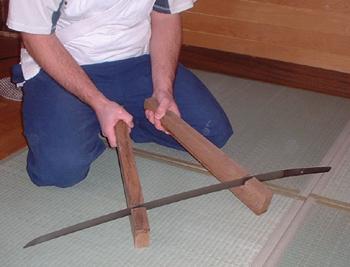
And straighten the blade with wood vice.
To make it exactly is very important to get good shape.
1) shaping
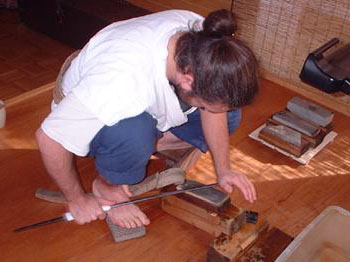
To restore the blade we shape it with stones.
We start with a rough stone, and step up toward finer one to make the shape finer.
Normally we use some kinds of stones, from rough to fine, Arato, Binsui, Kaisei, Chu-Nagura, Koma-Nagura, and Uchigumori.
For this work, the shape of the stone is very important.
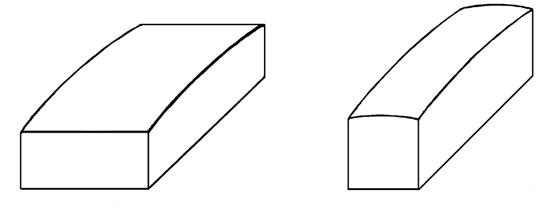
Wide stone is good for the flat surface (shinogi-ji) and the cutting surface. Narrow one is good for the back surface.
(Stones, there are two kinds, natural stone and artificial one. Each kind has good point.)
ARATO stone
The most rough stone.
We use it only for fresh borne blade or deep rusted one, to make a proper shape.
Hold the blade with right angle to the stone, and push the arms forward.
For the flat surface (shinogi-ji), a little slant angle is not so bad.
For the back surface, hold the blade 45 degrees to the stone, and push forward.
The work is same to the next step BINSUI.
This step is the most important for the shaping.
The system is very simple but it is the most difficult in all steps of shaping.
Never grind too much steel.
We have to get the perfect shape with the least grinding.
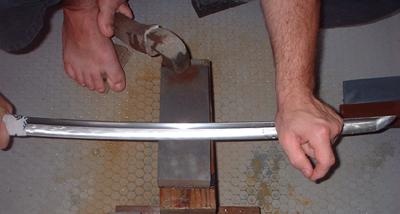
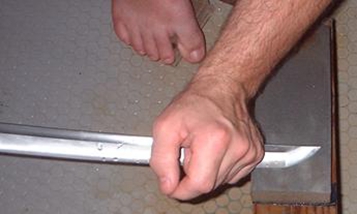
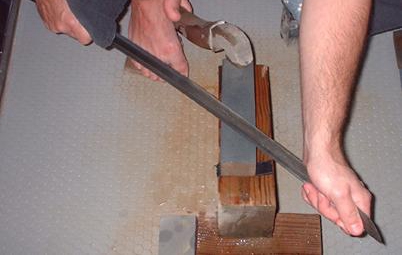 (work for the back surface)
BINSUI stone
Most of blades are started with this stone.
To remove rust and make a proper shape.
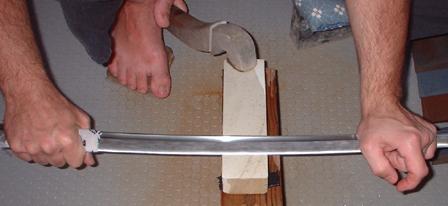
Be careful to save the meat on the cutting surface.
(Grind the stone surface often with another stone to keep its surface even)
KAISEI stone
To make the shape finer.
Hold the blade with 45 degrees to the stone, and push the arms forward.
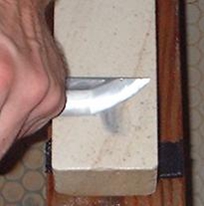
But the working system for kissaki never change with any stones.
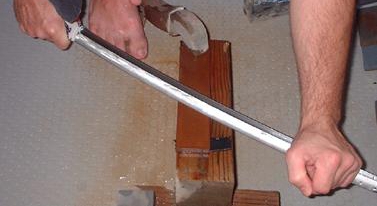
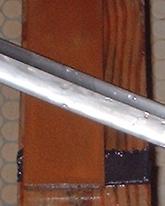
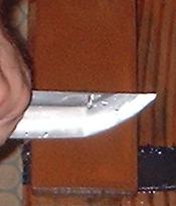
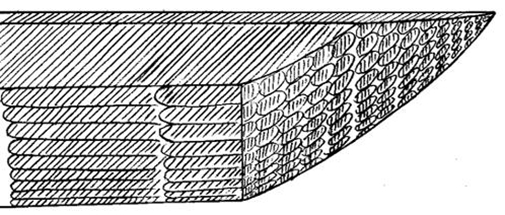 (the trace with KAISEI)
CHU-NAGURA stone
To make the shape finer.
From this step we never use artificial stones.
( In some case artificial stones are easy to be used by hobby polishers. )
Hold the blade 45 degrees to the stone, and move the blade along the blade's length.
The work looks like pushing the blade toward the left hand.
The trace should be parallel to the length or a little slant.
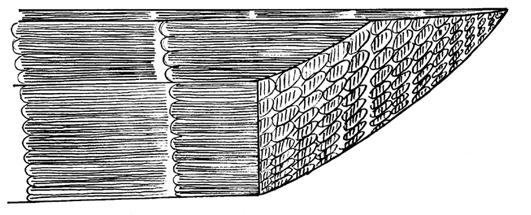 (the trace of CHU-NAGURA)
KOMA-NAGURA stone
To make the shape finer.
This stone is a little finer and harder than CHU-NAGURA stone.
The work is same to CHU-NAGURA step.
But the trace has to be very parallel to the length.
UCHIGUMORI stone
To complete the shape and to make the character of the blade come up.
Hold the blade the same way as in the previous step.
But the working direction is opposite.
It is pulling the blade carefully towards your right hand.
Then every surface is completely shaped, and the characters come up. (hamon, layer pattern and etc.)
Want a unique sword? Feel free to contact us:
Email: lyuesword@hotmail.com
Website: www.lyuesword.com
Custom Sword Page: www.lyuesword.com/Custom-Sword/customization-options/Create-Your-Own-Swords
The first is shaping, next is polishing.
These two steps are very different on their action.
And the shaping is the most important for the blade, and most difficult in the polishing work.
Preparation
Before starting the shaping work, we have to study the blade exactly to make a plan how shape it up.
And straighten the blade with wood vice.
To make it exactly is very important to get good shape.
1) shaping
To restore the blade we shape it with stones.
We start with a rough stone, and step up toward finer one to make the shape finer.
Normally we use some kinds of stones, from rough to fine, Arato, Binsui, Kaisei, Chu-Nagura, Koma-Nagura, and Uchigumori.
For this work, the shape of the stone is very important.
Wide stone is good for the flat surface (shinogi-ji) and the cutting surface. Narrow one is good for the back surface.
(Stones, there are two kinds, natural stone and artificial one. Each kind has good point.)
ARATO stone
The most rough stone.
We use it only for fresh borne blade or deep rusted one, to make a proper shape.
Hold the blade with right angle to the stone, and push the arms forward.
For the flat surface (shinogi-ji), a little slant angle is not so bad.
For the back surface, hold the blade 45 degrees to the stone, and push forward.
The work is same to the next step BINSUI.
This step is the most important for the shaping.
The system is very simple but it is the most difficult in all steps of shaping.
Never grind too much steel.
We have to get the perfect shape with the least grinding.
(work for the cutting surface and kissaki with an artificial ARATO stone)
 (work for the back surface)
BINSUI stone
Most of blades are started with this stone.
To remove rust and make a proper shape.
Be careful to save the meat on the cutting surface.
(Grind the stone surface often with another stone to keep its surface even)
(work with a natural BINSUI stone)
KAISEI stone
To make the shape finer.
Hold the blade with 45 degrees to the stone, and push the arms forward.
But the working system for kissaki never change with any stones.
(work with an artificial KAISEI stone)
 (the trace with KAISEI)
CHU-NAGURA stone
To make the shape finer.
From this step we never use artificial stones.
( In some case artificial stones are easy to be used by hobby polishers. )
Hold the blade 45 degrees to the stone, and move the blade along the blade's length.
The work looks like pushing the blade toward the left hand.
The trace should be parallel to the length or a little slant.
 (the trace of CHU-NAGURA)
KOMA-NAGURA stone
To make the shape finer.
This stone is a little finer and harder than CHU-NAGURA stone.
The work is same to CHU-NAGURA step.
But the trace has to be very parallel to the length.
UCHIGUMORI stone
To complete the shape and to make the character of the blade come up.
Hold the blade the same way as in the previous step.
But the working direction is opposite.
It is pulling the blade carefully towards your right hand.
Then every surface is completely shaped, and the characters come up. (hamon, layer pattern and etc.)
Want a unique sword? Feel free to contact us:
Email: lyuesword@hotmail.com
Website: www.lyuesword.com
Custom Sword Page: www.lyuesword.com/Custom-Sword/customization-options/Create-Your-Own-Swords
Recently Reviews
Read MoreLeave a Reply
Your email address will not be published.Required fields are marked. *